
Seyed Ziaeddin Alborzi, PhD, Senior Data & AI Go to Market at NTT DATA
Published in the June edition of the Gaia-X Magazine
Dataspace4Health is a Luxembourg-based Gaia-X Lighthouse project for health, moving from reference architecture to concrete, testable open-source components for trusted health data sharing. It provides technical rails for governed, sovereign and traceable data exchange, designed to support EHDS-aligned secondary use under the appropriate governance authorities, not to centralise data or replace existing health-governance authorities.
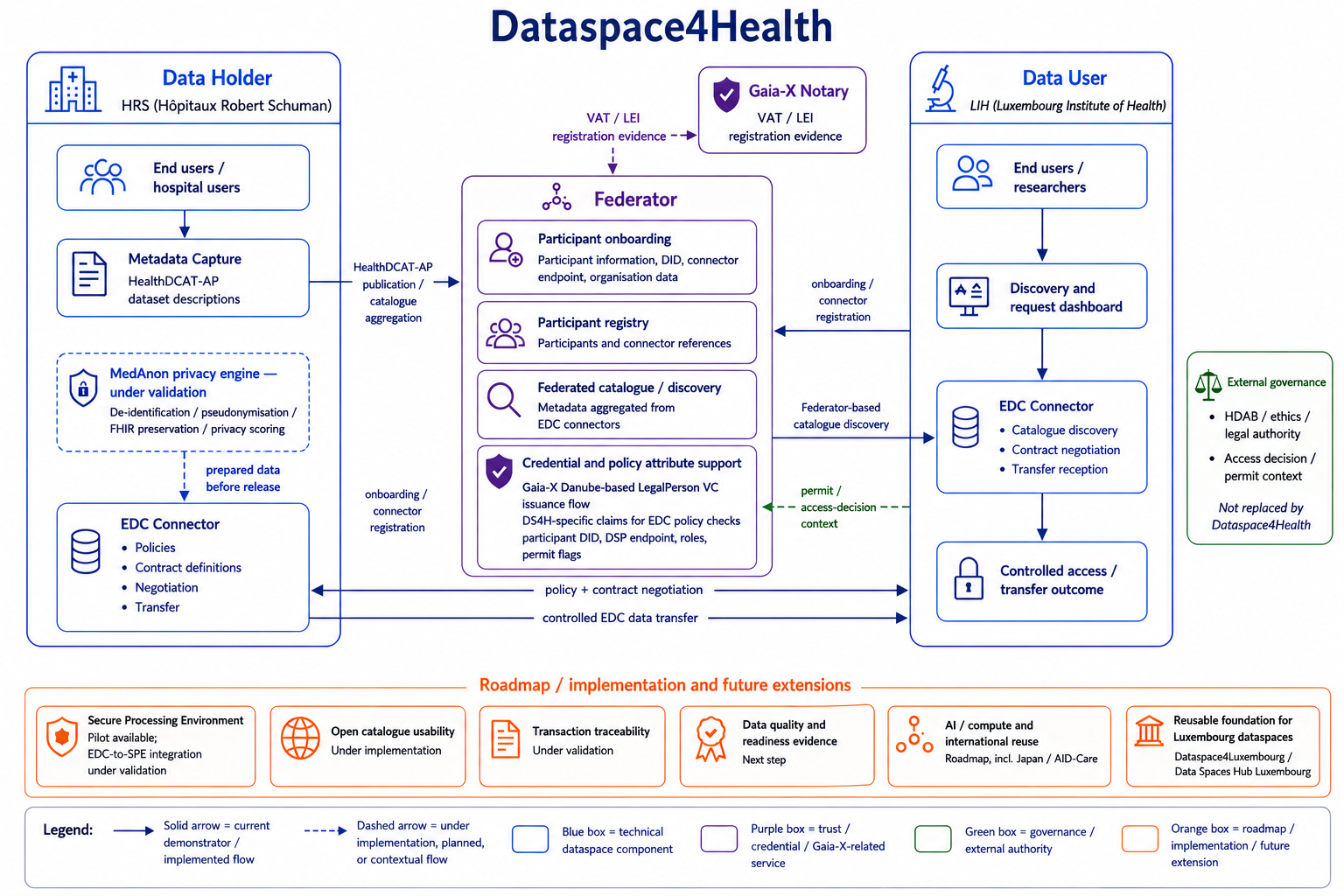
The project connects healthcare and research actors around a federated model: data holders keep control, data users discover and request datasets through common mechanisms, and exchange is framed by identity, metadata, policy, contract and traceability capabilities. This is being applied to two high-value scenarios, diabetes digital twin and precision oncology, where fragmented data across hospitals and research institutions slows innovation.
A key milestone has been the demonstrated end-to-end Eclipse Dataspace Connector flow between HRS (Hôpitaux Robert Schuman) as data holder and LIH (Luxembourg Institute of Health) as data user, using Federator-based catalogue capabilities, policy and contract definition, negotiation, and data transfer through the participant dashboard. Alongside this, the pilot includes deployed connector instances for HRS and LIH, Federator-supported onboarding, and HealthDCAT-AP metadata capture.
Onboarding and trust establishment have also advanced. Dataspace4Health uses a Gaia-X Danube-based credential approach in which the Federator generates and signs LegalPerson Verifiable Credentials. Registration numbers are checked through the Gaia-X Notary, and credentials are used inside the consortium trust model. They extend the LegalPerson model with Dataspace4Health-specific onboarding and connector claims such as participant DID, DSP endpoint, supported protocols, jurisdiction and roles.
A Metadata Capture component supports HealthDCAT-AP-based dataset descriptions, while a synchronisation service updates EDC assets from published metadata, linking rich health metadata to exchange and reducing manual work for data holders.
For data preparation, Dataspace4Health is complemented by MedAnon, a rule-driven privacy engine under development. It is designed to support de-identification, pseudonymisation, clinical text protection, FHIR structure preservation, privacy scoring and auditable release decisions, bridging privacy requirements and technical controls before reuse.
A Secure Processing Environment pilot is available as a trusted processing capability, while direct EDC-to-SPE integration is still under implementation; the project is not yet claiming a fully operational chain but is building toward controlled delivery into it.
Beyond the health pilot, Dataspace4Health also creates reusable foundations for Luxembourg’s wider dataspace community. The same building blocks can support other verticals under the Dataspace4Luxembourg direction and contribute to the Data Spaces Hub Luxembourg community. The project also prepares the ground for international health data exchange, including future collaboration with Japan through Artificial Intelligence for neurodegenerative diseases Care (AID-Care) project.
Next steps focus on hardening the operational chain: EDC-to-SPE integration, open catalogue usability, transaction logging and audit capabilities, data quality and readiness evidence, and stronger alignment with EHDS secondaryuse workflows. Dataspace4Health demonstrates how Gaia-X health-dataspace principles become practical, trusted and interoperable components.