

Gaia-X has been referenced by the European Commission in its Cloud Sovereignty Framework, confirming the initiative’s role in shaping Europe’s approach to trusted, interoperable, and sovereign cloud services. The framework, developed by the Directorate-General for Digital Services, explicitly draws on Gaia-X policy rules and architecture as part of the European foundation for defining and assessing cloud sovereignty.
The Cloud Sovereignty Framework establishes a structured and operational definition of sovereignty for cloud services procured by EU institutions. It complements existing security and certification schemes by introducing sovereignty-specific objectives covering strategic autonomy, legal and jurisdictional control, data and AI governance, operational resilience, supply chain transparency, technological openness, and compliance with EU law. In this context, the Commission identifies Gaia-X as one of the European initiatives that have contributed to clarifying what sovereignty means in practical, enforceable terms.
Ulrich Ahle, the CEO of Gaia-X, has stated: “The European Commission’s Cloud Sovereignty Framework confirms that digital sovereignty is not a slogan, but a set of concrete, verifiable requirements. By referencing Gaia-X, the Commission recognises the importance of trust, interoperability, and compliance by design as foundations for Europe’s digital infrastructure. Gaia-X was created to translate European values into operational reality, and this framework shows how those principles are becoming embedded in Europe’s approach to cloud and data services.”
By referencing Gaia-X, the Commission recognises the relevance of its trust framework and architectural principles in translating European digital values into verifiable technical and governance mechanisms. Gaia-X’s focus on transparency, interoperability, data control, and avoidance of vendor lock-in aligns closely with the objectives set out in the Cloud Sovereignty Framework, particularly in areas such as technology sovereignty, operational sovereignty, and data and AI sovereignty.
The framework also introduces a methodology for assessing cloud services through Sovereignty Effectiveness Assurance Levels and a Sovereignty Score, reinforcing the importance of measurable and auditable criteria. Gaia-X’s approach to machine-verifiable compliance, federated governance, and open standards directly supports this ambition to move beyond declarative claims of sovereignty toward demonstrable assurance.
This reference marks an important milestone for Gaia-X and its ecosystem. It confirms that the initiative’s work on trust, interoperability, and data spaces is aligned with the European Commission’s long-term vision for digital infrastructure. It also reinforces Gaia-X’s role as an enabling layer that supports European institutions, public administrations, and industry in deploying cloud and data services under clear European rules.
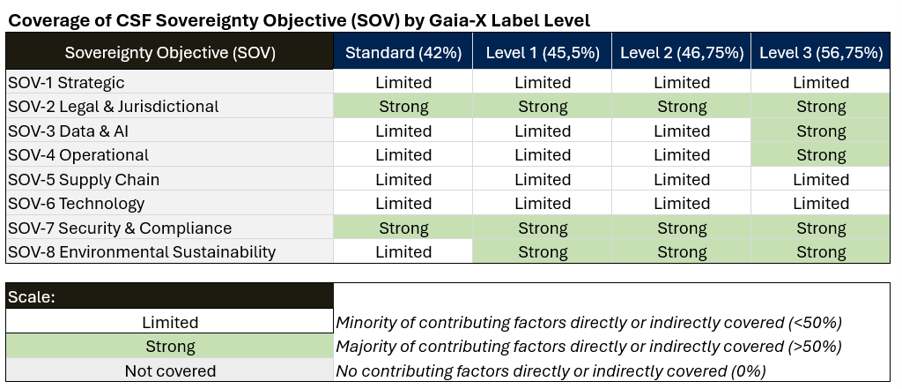 On a practical level, Gaia-X Label Standard Compliance and Label Levels 1 and 2 can be assessed against the lower sovereignty objectives mainly through legal and jurisdictional control, security, and compliance, while still showing only limited coverage on strategic, supply chain, and technology sovereignty. Label Level 3 extends more clearly into data and AI sovereignty, operational sovereignty, and environmental sustainability. This should be read as an indicative mapping only, since the Commission’s assessor questionnaire is not public and exact SEAL-by-SEAL equivalence cannot be confirmed.
The overlap between the Cloud Sovereignty Framework and Gaia-X’s Labelling criteria further underlines the opportunity to translate sovereignty principles into common, practical and verifiable criteria that can support adoption across the market. As Europe advances its digital priorities in cloud, data, AI, and cybersecurity, Gaia-X will continue to contribute to a coherent, federated digital ecosystem in which sovereignty is not defined by isolation, but by control, transparency, and trust by design.